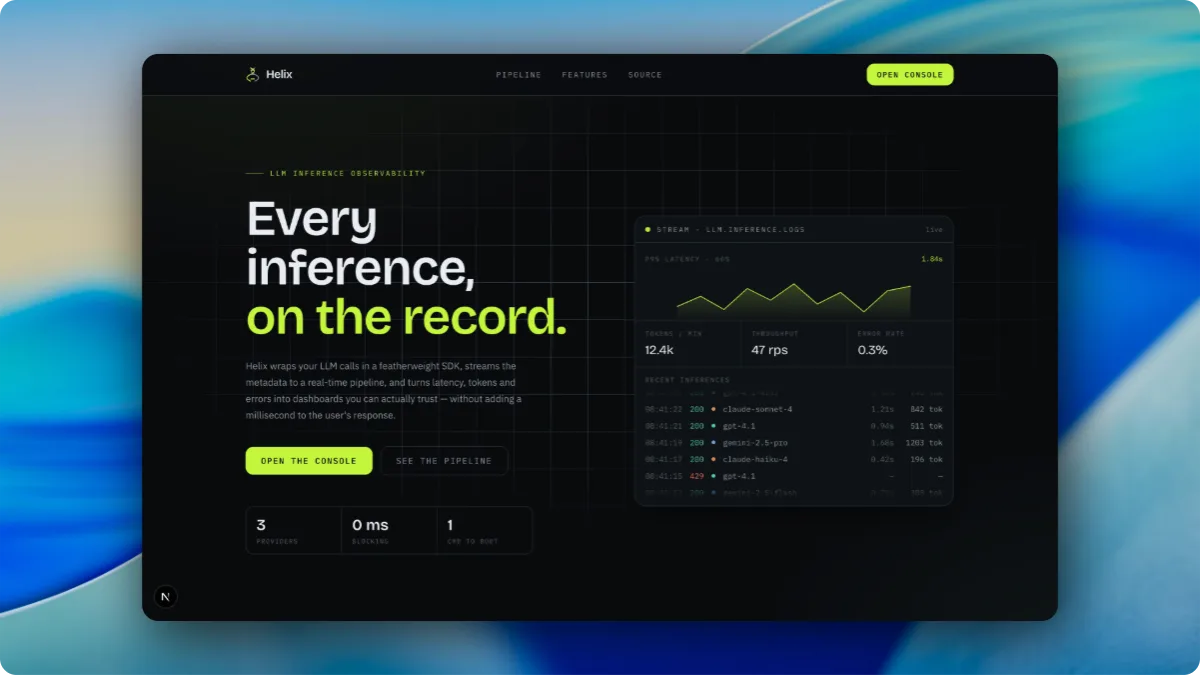
The problem
LLM applications need visibility into latency, token usage, and errors, but the logging must not slow down the response the user is waiting for.
Who it is for
Teams building LLM-powered applications.
What I built
An SDK that wraps multi-provider LLM calls (Anthropic, OpenAI, Google, and 300+ models via OpenRouter) and ships latency, token, error, and session metadata through Kafka to an ingestion pipeline backed by PostgreSQL and TimescaleDB. Grafana dashboards show real-time latency, throughput, and error metrics. A Next.js chatbot demonstrates the SDK.
Built with
- Frontend
- React
- Next.js 16
- TanStack Query
- Tailwind CSS
- SSE
- Backend
- Node.js
- Fastify 5
- Zod
- TypeScript
- Data
- PostgreSQL
- TimescaleDB
- Redis
- Drizzle
- Messaging
- Redpanda (Kafka)
- LLM Providers
- Anthropic
- OpenAI
- Gemini
- OpenRouter
- Observability
- Prometheus
- Grafana
- Infra
- Docker Compose
- AWS EKS
- Helm
- Turborepo
- pnpm
In detail
- Models via one OpenRouter key
- 300+
- Providers behind one client
- 4
- Added to response path
- 0ms
- Full-stack Docker boot
- 1 cmd
Architecture
A Turborepo pnpm monorepo: three apps and three shared packages.
apps/
  web/         Next.js 16 chat UI (App Router, Turbopack)
  api/         Fastify API gateway: conversation CRUD, SSE streaming
  ingestion/   Kafka consumer + PostgreSQL writer
packages/
  sdk/         Unified LLM client (Anthropic, OpenAI, Gemini, OpenRouter) + redaction
  db/          Drizzle schema + TimescaleDB hypertable SQL
  types/       Shared Zod schemas + inferred TypeScript types
infra/
  docker-compose.yml   one-run local stack
  k8s/                 Helm charts for EKS (one per service)
  grafana/             dashboards + provisioning
Data flows one way to the user and out-of-band to storage:
User -> Next.js (SSE) -> Fastify API Gateway -> SDK Wrapper -> LLM Provider
                                                    |
                                         Kafka: llm.inference.logs
                                                    |
                                       Ingestion Service -> PostgreSQL -> Grafana
Decision
Decoupled write path
The SDK emits one Kafka event per call, fire-and-forget, and ingestion
consumes and persists it out-of-band. The gateway never writes
inference_logs directly. Kafka is the buffer: an ingestion slowdown grows
consumer lag rather than dropping data or stalling replies, and consumers
scale independently in one consumer group.
Ingestion flow
Call completes in the SDK
The SDK measures
firstTokenMsandlatencyMs, builds one versionedKafkaLogPayloadenvelope (schemaVersion,eventId,emittedAtplus call metadata), and redacts the previews.Fire-and-forget emit
The payload is emitted to the
llm.inference.logstopic with a 2000ms producer timeout. If Kafka is slow or down, the SDK logs to stderr and moves on: the user already has their response.Validate and redact
apps/ingestionconsumes the topic and runs the pipeline: JSON parse,KafkaLogPayloadSchemaZod validation, a second PII redaction layer, then insert via Drizzle.Persist or dead-letter
The DB write is retried up to 3 times. Validation failures or persistent write failures route to the
llm.inference.dlqtopic withx-dlq-*headers carrying the original raw bytes.Never stall
processMessagenever throws: every path resolves to a write or a DLQ route, so the consumer offset always advances and the loop never stalls. Grafana reflects new calls within seconds.
Key features
Unified multi-provider SDK
One LLMClient interface over Anthropic, OpenAI, and Gemini direct SDKs
plus OpenRouter, which reuses the openai SDK against
openrouter.ai/api/v1 for one key and 300+ models. Pure TypeScript, no
HTTP layer of its own.
Zero-latency observability
Inference metadata is captured and shipped without touching the response path. The emit is asynchronous and fire-and-forget, so logging can never slow or block the user reply.
TimescaleDB hypertable
inference_logs is a hypertable partitioned on request_at. Time-bucketed
dashboard queries (p50/p95/p99 latency, throughput per minute) run orders
of magnitude faster than on a plain table, with no change to the query API.
Streaming end to end
SSE from the browser through the gateway to the SDK, which intercepts the
stream to measure firstTokenMs. A client disconnect mid-stream aborts the
upstream LLM call and emits a cancelled log.
Two-layer PII redaction
Email, phone, SSN, and credit-card patterns are redacted once in the SDK before emit and again in ingestion before the DB write. A raw payload never reaches the database even if one layer is bypassed.
Graceful provider gating
hasProvider(name) lets the gateway refuse a request before hijacking the
SSE response, returning 503 provider_not_configured so the client shows a
friendly message instead of a silent stream close.
Redis context cache
A trailing 10-message window is read from ctx:{conversation_id} (24h TTL),
removing a DB round-trip per message. A cold miss rebuilds the window from
redacted DB history.
Conversation lifecycle
List, resume, and archive conversations from the UI. Cancel closes the SSE
stream, persists partial output, and sets status='cancelled'. Cancel never
deletes: a cancelled conversation stays viewable and posting to it returns
409.
Data model
Four PostgreSQL tables, Drizzle schema as the source of truth:
conversations: one row per chat session, holding provider, model, status.messages: every user, assistant, and system turn, content always redacted.inference_logs: one row per LLM API call, a TimescaleDB hypertable.providers: provider configuration, name, base URL, active flag.
Note
No primary key on the hypertable
TimescaleDB hypertables cannot carry a primary key that excludes the
partitioning column, so inference_logs keeps an id with a default but no
PK constraint. Idempotency is handled upstream via the payload eventId
rather than a database uniqueness guarantee.
Tradeoff
Fire-and-forget tradeoff
Guaranteeing the user response is never blocked means a Kafka outage drops log events rather than queueing them, so observability data can be lost during an incident. Acceptable because observability is non-critical relative to the user reply. A durable disk spool or outbox is the planned improvement.
Outcome
Helix is an LLM observability system with a unified multi-provider SDK, an event-driven ingestion pipeline with Zod validation and a dead-letter queue, a TimescaleDB hypertable tuned for time-series dashboard queries, and Grafana dashboards for latency, throughput, and errors. The central invariant holds throughout: the log write path never blocks the user response. The services are stateless, Kafka absorbs backpressure, and Helm charts cover deployment to AWS EKS.
Challenges
- Capturing full inference metadata (latency, first-token time, tokens, status, session IDs) without adding any latency to the user-facing response path
- TimescaleDB hypertable on inference_logs, which cannot carry a primary key excluding the partitioning column, so idempotency moves upstream to the Kafka payload eventId
- A fire-and-forget log emit with a 2000ms producer timeout, so a broker outage degrades observability instead of blocking the reply
- An ingestion processMessage that never throws: every path resolves to a DB write or a DLQ route so the kafkajs consumer offset always advances
- Two-layer PII redaction (SDK before emit, ingestion before DB write) so a raw payload never reaches the database even if one layer is bypassed
- SSE streamed end to end with SDK stream interception measuring first-token latency, plus client-disconnect abort of the upstream LLM call
What I learned
- Decoupling the user response path from the log write path through Kafka lets the ingestion service scale independently in its own consumer group
- A hypertable partitioned by request_at makes p50/p95/p99 latency and throughput range scans orders of magnitude faster without changing the query API
- Redpanda over Kafka: single binary, no ZooKeeper for local dev, Kafka-compatible API so a production swap is config-only
- One unified LLMClient over four providers with hasProvider(name) lets the gateway refuse a request up front with a 503 when a key is missing
- Kafka as a buffer turns an ingestion slowdown into growing consumer lag rather than dropped data or stalled user responses
- Drizzle schema as the single source of truth with drizzle-kit push, keeping the only hand-written SQL to the idempotent hypertable conversion

Have a role in mind?
Send me a message on X with the role and a link to the posting. My resume has the rest.